Graphic performance plays a fundamental role in user experience, whether for video games, virtual reality applications, or design work. To achieve smooth and detailed graphics, it is essential to use appropriate tools that optimize every aspect of the visual production chain.
Among these tools are benchmarking software, graphic debuggers, and shader optimizers. Each of these instruments offers specific features to identify and fix bottlenecks, test hardware limits, and improve visual quality without sacrificing performance.
Essential Tools for Optimizing Graphic Performance
In the field of graphic performance, several tools stand out for their effectiveness and precision. For industry experts, these instruments are indispensable for maximizing the yield of graphics cards while ensuring optimal visual quality.
High-End Graphics Cards
The GeForce and Radeon series graphics cards represent the pinnacle of current performance. The Nvidia GeForce RTX 4090 and Nvidia GeForce RTX 4080 offer an excellent balance between performance, VRAM memory, and rendering capabilities. On the AMD side, the Radeon RX 7800 XT and Radeon RX 7800 are prized for their image quality and solid performance at a reasonable price. These cards utilize NVIDIA Turing and AMD Navi technologies, respectively, allowing for ray tracing to achieve ultra-realistic lighting effects.
Software and Operating Systems
Software like AVG TuneUp plays a fundamental role in optimizing performance and increasing frame rates. The Windows 10 and Windows 11 operating systems include Game Mode, designed to optimize the system during gaming sessions.
Benchmarking and Monitoring Tools
To test your hardware capabilities, benchmarking software like 3DMark is recommended. It allows you to evaluate your graphics card’s performance under extreme conditions. For real-time monitoring, Riva Tuner is essential. It offers advanced monitoring and overclocking features, allowing you to adjust settings to get the most out of your hardware.
- 3DMark for performance evaluation
- Riva Tuner for monitoring and overclocking
- AVG TuneUp for performance optimization
For experts looking to optimize every aspect of their graphic performance, these tools are an essential toolkit.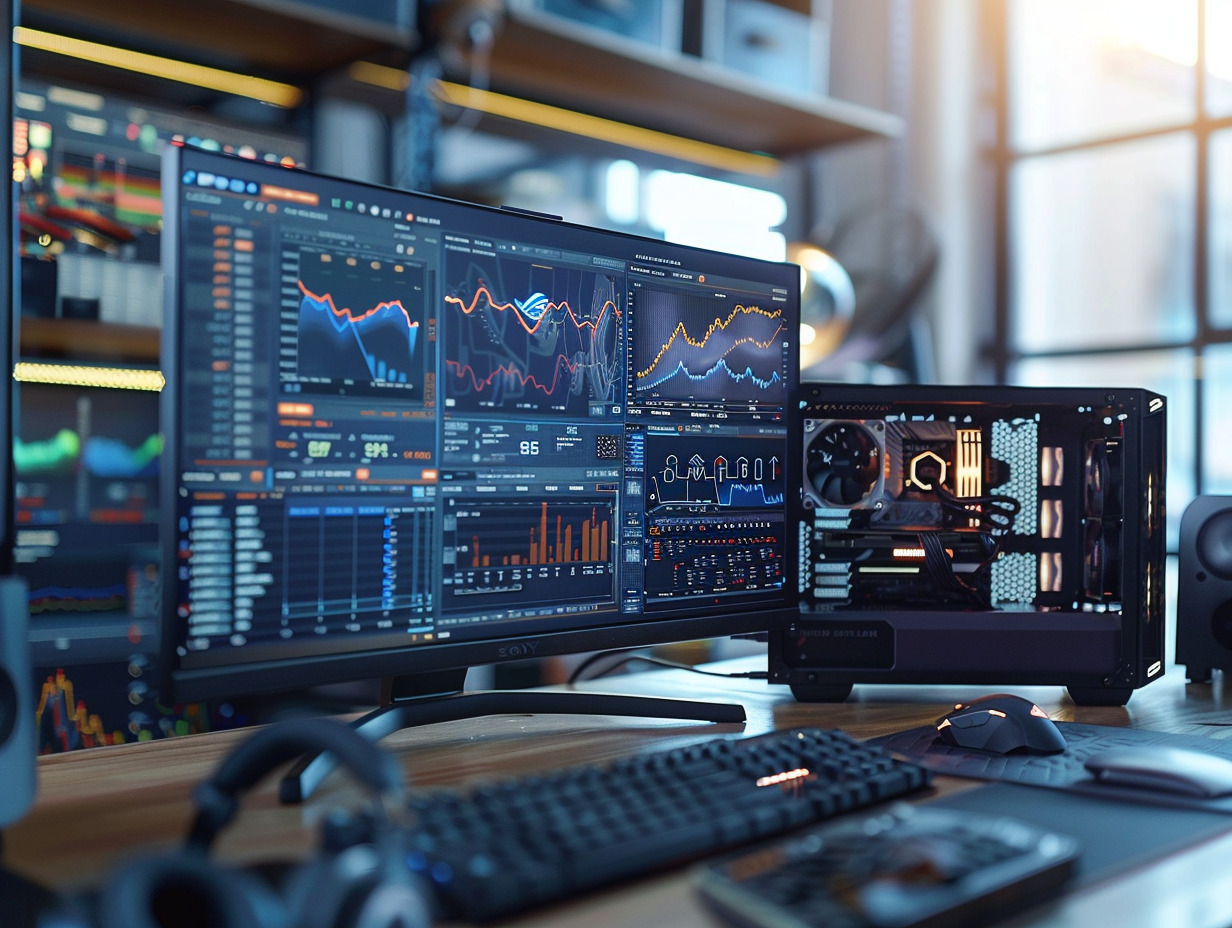
How to Use These Tools to Maximize Performance
To fully exploit the capabilities of your graphics cards, you need to follow a methodical and well-informed approach. Here are the key steps:
Updating Drivers
To ensure optimal performance, make sure to always keep your drivers up to date. Manufacturers like Nvidia and AMD regularly release updates that improve compatibility and performance for video games such as Baldur’s Gate 3, GTA V, or Cyberpunk 2077.
Optimizing Settings
Use the configuration panels provided by Nvidia and AMD to adjust your graphics card settings. For example, enable ray tracing for realistic lighting effects in compatible games, or adjust quality settings to balance performance and visuals. For games like Call of Duty or Fortnite, specific tweaks can significantly enhance your gaming experience.
Using Monitoring and Overclocking Software
Tools like Riva Tuner allow you to monitor the temperature and frequency of your graphics processor in real time. For safe overclocking, follow the manufacturers’ recommendations and use software like Asus GPU Tweak. Be sure to monitor the temperature to avoid overheating.
- Regularly update drivers
- Optimize settings via configuration panels
- Use monitoring software like Riva Tuner to track performance
By applying these methods, you can get the most out of your graphics cards, whether for demanding games like Cyberpunk 2077 or lighter titles like Fortnite.