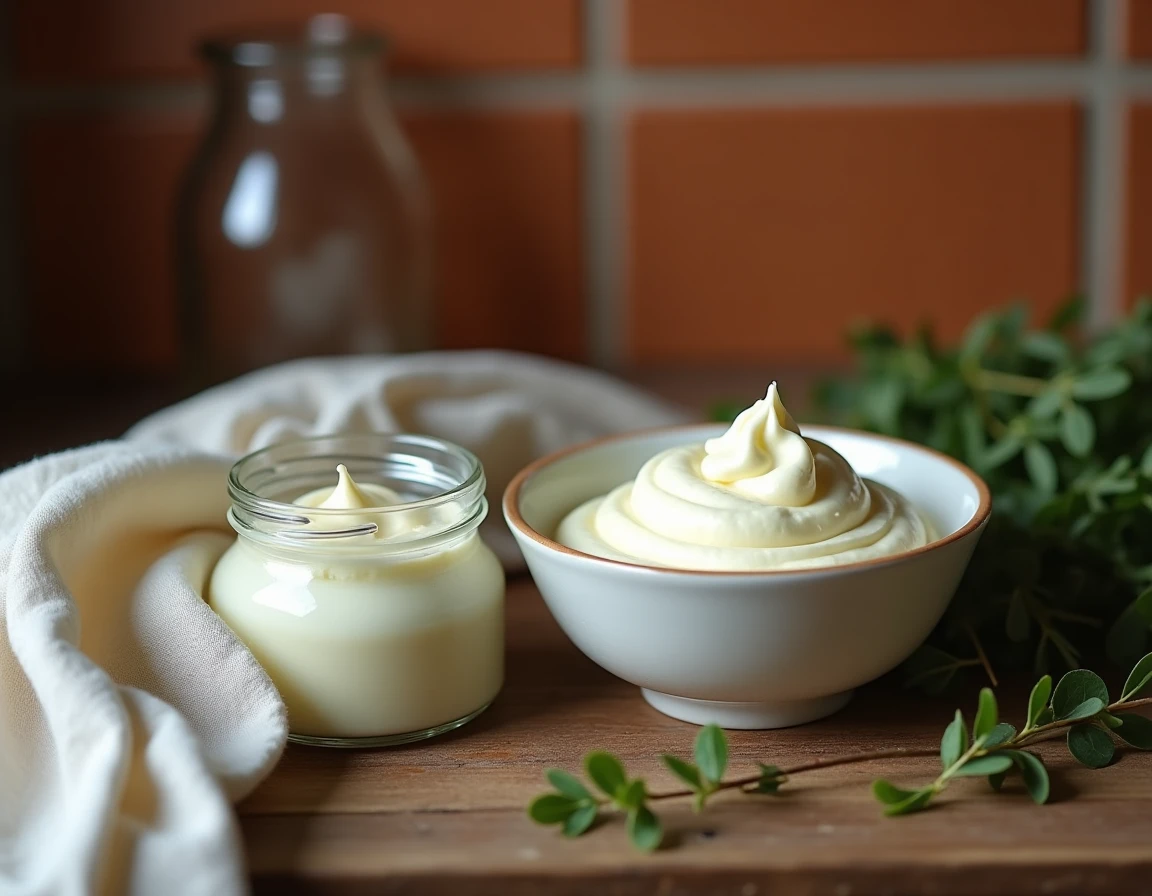
Mascarpone and crème fraîche share a milky appearance that leads to them being interchanged thoughtlessly. However, their behavior in cooking, their stability in a mousse, and their regulatory status diverge on points we consider crucial for the final result of a recipe.
Regulatory status and composition: crème fraîche and mascarpone do not play in the same category

Under European law, crème fraîche is a dairy product made exclusively from milk, governed by Regulation (EU) No 1308/2013. Mascarpone, on the other hand, falls under the classification of fresh cheese. This distinction is not trivial: it involves different fat content thresholds, distinct acidification processes, and specific rules regarding the potential addition of stabilizers or thickeners.
In collective catering or industrial production, substituting one for the other without verifying labeling compliance exposes one to a naming defect. For the amateur cook, the practical consequence is more direct: crème fraîche contains more free water, while mascarpone concentrates its dry matter. This water/fat ratio conditions everything else.
Understanding the difference between crème fraîche and mascarpone technically prevents texture errors that can affect everything from the filling of a cake to the sauce of a pasta dish.
Cooking stability and thermal stability: the real criterion for choice in savory cooking
Thick crème fraîche holds up well to heat. We use it to deglaze a pan, bind a sauce, or top a gratin without fearing it will curdle. Its slight acidity, inherited from lactic fermentation, adds a flavor base that mascarpone does not replicate.
Mascarpone coagulates more quickly under the influence of high heat and an acidic environment (white wine, lemon juice, tomato). In a long-simmered tomato sauce, it can curdle if added too early. However, when incorporated off the heat or at the end of cooking, it provides a richer and rounder creaminess than crème fraîche.
The rule we apply is simple:
- Long cooking, acidic environment, deglazing: prioritize thick crème fraîche, which withstands temperature without destabilizing
- Finishing a sauce, creamy risotto, vegetable velouté served immediately: mascarpone provides superior creaminess due to its fat concentration
- Quiche, flan mixture, gratin dauphinois: crème fraîche remains the logical choice for its fluidity and ability to evenly saturate a preparation baked in the oven
Texture and aeration: mascarpone in pastry, crème fraîche in light desserts
The gap is most pronounced in pastry. Mascarpone aerates more slowly than crème but offers a more stable structure over time. A tiramisu made with mascarpone holds its shape for several days in the refrigerator. A mousse made with whipped crème fraîche loses volume more quickly.
Mascarpone whipped cream, widely used in cake design, illustrates this complementarity well. By combining liquid cream (for aeration) and mascarpone (for stability), you achieve a firm coating that smooths with a comb without collapsing. Replacing mascarpone with thick crème fraîche in this formula would yield a result that is too soft, unable to hold on the sides of a layered cake.
For desserts where lightness is paramount (airy panna cotta, fruit fool), crème fraîche prevails. Its free water content promotes a melting texture rather than a dense one.
Freezing and batch cooking: a clear advantage for mascarpone
Technical sheets from dairy manufacturers published in recent years converge on one point: preparations based on mascarpone freeze better than those based solely on crème fraîche. The reason lies in the higher dry matter content of mascarpone, which limits the amount of free water likely to form ice crystals.
In practice, a frozen tiramisu mixture that is then thawed in the refrigerator retains an acceptable texture. A quiche made with crème fraîche, frozen after cooking, often releases liquid upon thawing and presents a soggy bottom.
For batch cooking creamy sauces intended for the freezer, we recommend incorporating a portion of mascarpone into the base. The result upon reheating remains more homogeneous.
Substituting crème fraîche for mascarpone: recipes where the replacement works and those where it fails
Not all substitutions are a simple volume-for-volume exchange. Mascarpone is richer and denser: replacing an equal amount of crème fraîche weighs down the recipe. Conversely, using crème fraîche instead of mascarpone dilutes the texture.
- Carbonara sauce: mascarpone works, provided it is loosened with a bit of pasta cooking water to compensate for its density
- Tiramisu: crème fraîche alone does not hold, mascarpone remains the technically suitable choice
- No-bake cheesecake: a mixture of the two (about two-thirds mascarpone, one-third crème fraîche) provides a good compromise between firmness and lightness
- Velouté soup: crème fraîche integrates better due to its fluidity, while mascarpone can leave lumps if the soup is too hot
Adapting the quantity to the fat content and water content remains key. Reducing the amount of mascarpone by about a quarter when replacing crème fraîche allows for a texture balance close to the original.
The current trend of combining classic mascarpone and plant-based cream to lighten certain desserts (mousses, revamped tiramisus) confirms that mascarpone lends itself well to mixing. Crème fraîche, more sensitive to associations with vegetable fats, tends to separate in these hybrid formulas. Choosing between the two is less about designating a winner than about identifying the dominant constraint of each recipe: stability, cooking, freezing, or lightness.