
Preparing a meal with a non-stick pan, a knife that crushes instead of slicing, or a pot with a handle that burns your fingers: these situations resonate with everyone. The choice of your kitchen equipment at home directly influences the pleasure of cooking and the quality of your dishes. Before filling your cupboards, some concrete guidelines can help avoid unnecessary purchases and keep only what is truly useful.
Dishwasher compatibility and maintenance: the criterion that no one prioritizes when buying
Have you ever bought an attractive utensil in a store, only to realize after two weeks that it wasn’t dishwasher safe? This detail, rarely highlighted in traditional guides, can change the game on a daily basis.
In a household where cooking is frequent, the ease of maintenance determines whether a utensil will be used or stored at the back of the cupboard. A beautiful item made of raw wood or untreated cast iron requires manual care after each use. If you lack the time or desire, these pieces end up damaged or neglected.
Make it a habit to check three points before any purchase: dishwasher compatibility, resistance to thermal shock (transitioning from fire to washing without deformation), and ease of drying. A food-grade stainless steel or quality silicone utensil generally ticks these three boxes. When browsing kitchen equipment on À Nos Petits Fourneaux, these maintenance criteria serve as a good filter to refine your choices.

Cooking utensils: pan, pot, and casserole, the real choices
Cooking is the area where a poor choice is felt immediately. A pan that is too thin warps at high temperatures. A pot that is too heavy tires the wrist when draining pasta.
Choosing a pan based on your cooktop
Your cooktop determines the material of your pan. On an induction cooktop, only ferromagnetic bottoms work. On gas, you have more freedom, but the thickness of the bottom remains crucial for even heat distribution.
One high-quality versatile pan is better than three low-end models. Aim for a diameter suitable for your main use (meals for two people do not require the same size as those for a family).
Pots and stockpots: reasoning by use
Two pots of different sizes and a stockpot cover most domestic needs: heating water, preparing a sauce, simmering a dish. Stainless steel with a encapsulated bottom offers a good compromise between durability, lightweight, and compatibility with all types of cooktops.
- Medium pot (around 18 cm): sauces, reheating, cooking small amounts of vegetables
- Large pot (around 20-22 cm): pasta, soups, broths
- Stockpot with lid: stews, long cooking, bulk preparations
Knives and preparation tools: three blades are enough
Blocks of six or eight knives look impressive in a catalog. In practice, most home cooks use two to three blades at most.
A chef’s knife, a paring knife, and a peeler cover almost all cutting needs at home. The chef’s knife (wide blade, between 18 and 21 cm) slices, dices, and chops. The paring knife (short blade, around 9 cm) peels, trims, and works with precision. The peeler removes the skin from vegetables without wasting flesh.
Why avoid cheap complete sets? Because the quality of the steel and the balance of the blade vary greatly from one model to another. It is better to invest in two well-forged knives than in a block of eight soft blades. A good knife is recognized by its lasting sharpness and stable grip, not just its price.
Small kitchens and storage: adapting equipment to available space
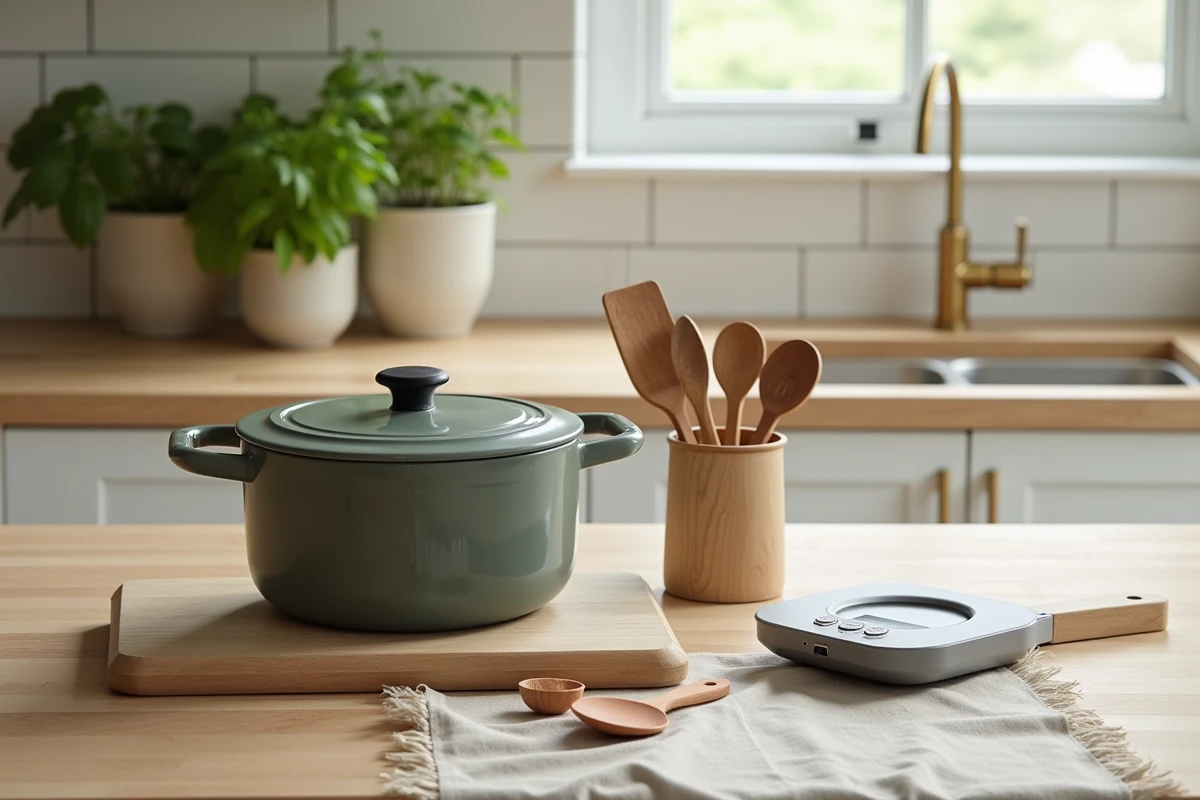
In an urban apartment, every centimeter of storage counts. Accumulating kitchen equipment without considering the available space quickly leads to overflowing drawers and inaccessible utensils.
Before buying, ask yourself a simple question: where will I store this item? If the answer is “I don’t know,” the purchase is likely unnecessary. Modularity and nesting are major assets for small spaces.
Favor accessories that serve multiple functions. A mixing bowl can double as a batter bowl. A thick cutting board can serve as an extra workspace. Stackable or magnetic utensils (magnetic strips for knives) free up space in drawers.
- Stackable stainless steel bowls: preparation, mixing, temporary storage
- Reversible cutting board: one side for meat, one side for vegetables
- Heat-resistant silicone spatula: replaces wooden spoon, rubber spatula, and classic spatula
- Collapsible colander: stores flat, unfolds for draining
Materials of kitchen utensils: stainless steel, silicone, or wood
The material of a utensil influences its lifespan, hygiene, and interaction with your food. Three families dominate domestic equipment.
Food-grade stainless steel remains the reference for pots, bowls, and preparation accessories. It does not react with acidic foods, is dishwasher safe, and resists shocks. Quality silicone is suitable for spatulas, whisks, and baking molds: it withstands high temperatures without releasing substances into food.
Wood remains valuable for cutting boards and spoons, provided you are willing to accept regular maintenance (oil, complete drying). Its advantage: it does not damage the sharpness of knives and feels pleasant in hand.
Well-chosen kitchen equipment does not rely on the quantity of accumulated products but on the suitability between your habits, your space, and the quality of each piece. Three good knives, two reliable pots, a pan suited to your cooktop, and a few versatile utensils form a solid foundation. Everything else can wait until the need truly arises.