
On a loading dock, the pallet we just filmed measures 80 cm wide, 120 cm long, and the cartons rise to 150 cm. Multiplying these three dimensions gives a net volume. The carrier, however, charges a different volume, often higher. Understanding this gap between the theoretical volume and the volume actually considered in transport helps avoid extra costs on each pallet shipment.
Theoretical volume vs. billable volume: what changes the calculation of a pallet
The basic formula remains simple: length x width x height, all converted to meters to obtain cubic meters. A standard Europe pallet (120 x 80 cm) loaded to 160 cm high gives 1.536 m³. We could stop there.
The problem begins when the cartons overflow the pallet. An overflow of a few centimeters on each side requires recalculating based on the actual footprint, not on the dimensions of the pallet itself. The carrier measures the outer envelope of the load, including the pallet. If packages exceed, it is the maximum dimension of the entire load that serves as the basis.
We then apply a cubic meter calculation method that takes into account the extreme dimensions: the widest, longest, and highest points of the wrapped load. This footprint volume is what the carrier uses to establish their rate, not the net volume of the goods alone.
In practice, the gap between net volume and billable volume can represent a significant portion of the transport cost, especially on poorly packaged or irregularly loaded pallets.
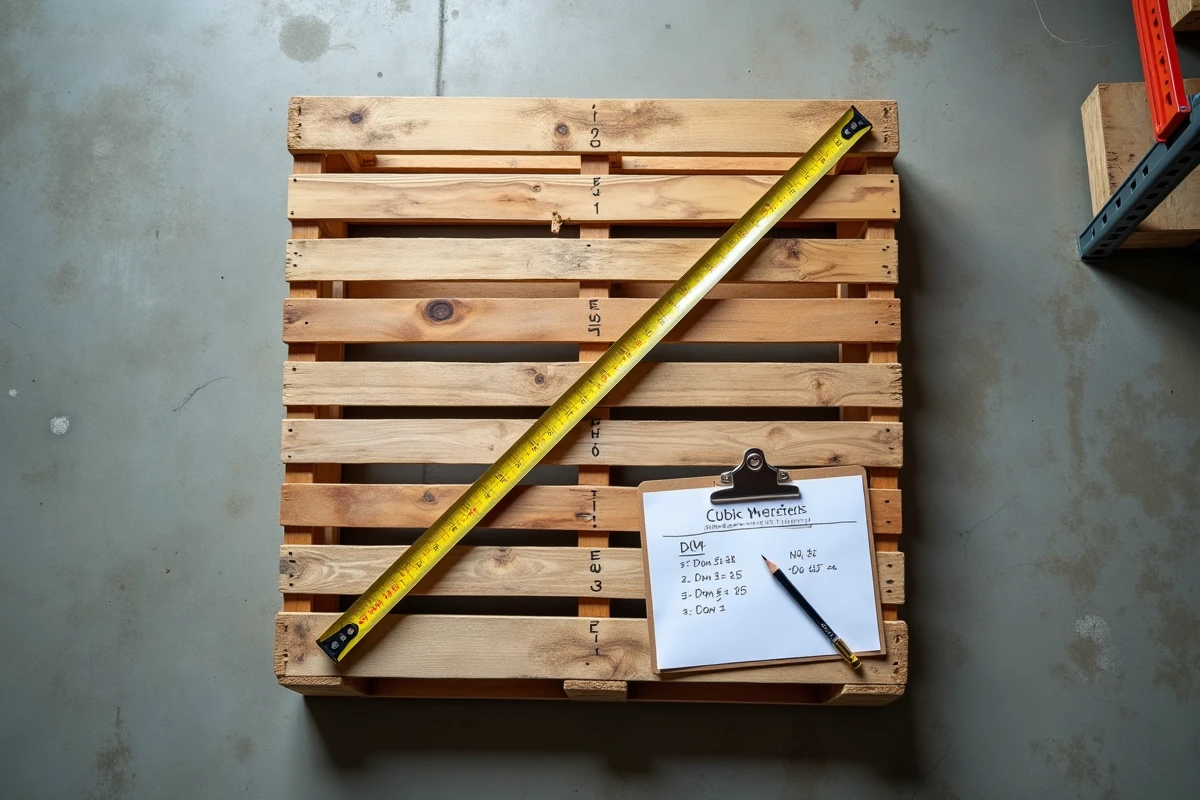
Correctly measuring the dimensions of a loaded pallet
Always measure the pallet once the loading is complete and the stretch film is applied. Taking measurements before wrapping exposes you to discrepancies: the film slightly compresses the load on the sides but can add volume on top if the dome is not flattened.
The three dimensions to record
- Overall length: from the furthest forward point to the furthest back point of the load, not from the wooden pallet. If a carton extends 5 cm on one side, add those 5 cm.
- Overall width: same logic on the perpendicular axis. Side overhangs count.
- Total height from the ground: include the thickness of the wooden pallet (generally around 15 cm for a Europe pallet). The carrier does not deduct the height of the pallet, as the pallet occupies that space in the truck.
With these three measurements in centimeters, divide each by 100 to convert to meters, then multiply. The result gives the volume in cubic meters of the footprint.
Pallet and loading constraints: why usable volume decreases
A standard tautliner truck offers an interior space of about 2.40 m wide. Two Europe pallets placed side by side across the width (80 + 80 = 160 cm) leave a residual gap between the pallets and the walls. This gap is not loadable but exists in the total volume of the vehicle.
Conversely, if the pallets are placed lengthwise (120 cm), a single pallet occupies half the width of the truck with an even larger wasted space. The orientation of the pallets directly affects the number of usable cubic meters per load.
Stacking and stacking
Not all pallets are stackable. A pallet of fragile or irregularly shaped products cannot support a second one on top. In this case, the space above the load, up to the ceiling of the truck, is wasted. The billed volume remains that of the pallet, but the volume immobilized in the vehicle can be double.
For stackable pallets, the calculation adjusts: we add the height of the two levels, including the intermediate pallet. Two 120 x 80 cm pallets stacked with loads rising to 100 cm and 80 cm, with two wooden pallets, give a unique footprint volume calculated as a single block.

From cubic meters to volumetric weight in transport
Volume alone is not enough to determine what we pay. Road carriers systematically compare the actual weight and the volumetric weight, then bill based on the higher of the two. The principle is simple: a pallet of cushions occupies a lot of space for a low weight, and the carrier cannot fill their truck by weight. They compensate by applying a conversion ratio.
In road transport, the commonly applied ratio is 1 m³ for 333 kg (returns vary on this point depending on carriers and countries). Therefore, we multiply the volume in cubic meters by this coefficient to obtain the volumetric weight.
- If the actual weight of the pallet exceeds the volumetric weight, we bill based on the actual weight.
- If the volumetric weight exceeds the actual weight, it is the volume that dictates the price.
- For light and bulky goods (empty packaging, foam, textiles), the volumetric weight almost always exceeds the actual weight.
Knowing the exact volume of your pallet allows you to anticipate which billing method will apply and to adjust the packaging accordingly. Reducing the loading height by a few centimeters, eliminating a side overhang, or using better-fitting cartons can shift billing from volumetric to weight-based.
Optimizing volume before shipping
The calculation does not stop at measurement. Once the volume is known, we can act on it. Reconfiguring the palletization plan to eliminate empty spaces between cartons mechanically reduces the total height. Every centimeter gained in height translates into saved cubic meters across an entire load.
Aligning the cartons flush with the edges of the pallet eliminates overhangs and brings the overall dimensions back to those of the pallet itself. Wrapping while maintaining a flat top, without a dome, prevents the carrier from measuring at the highest point of a bulging stack.
For regular shipments, recalculating the volume after each packaging modification provides a reliable basis for negotiating transport rates. A controlled volume means predictable costs and a better-filled truck for everyone.